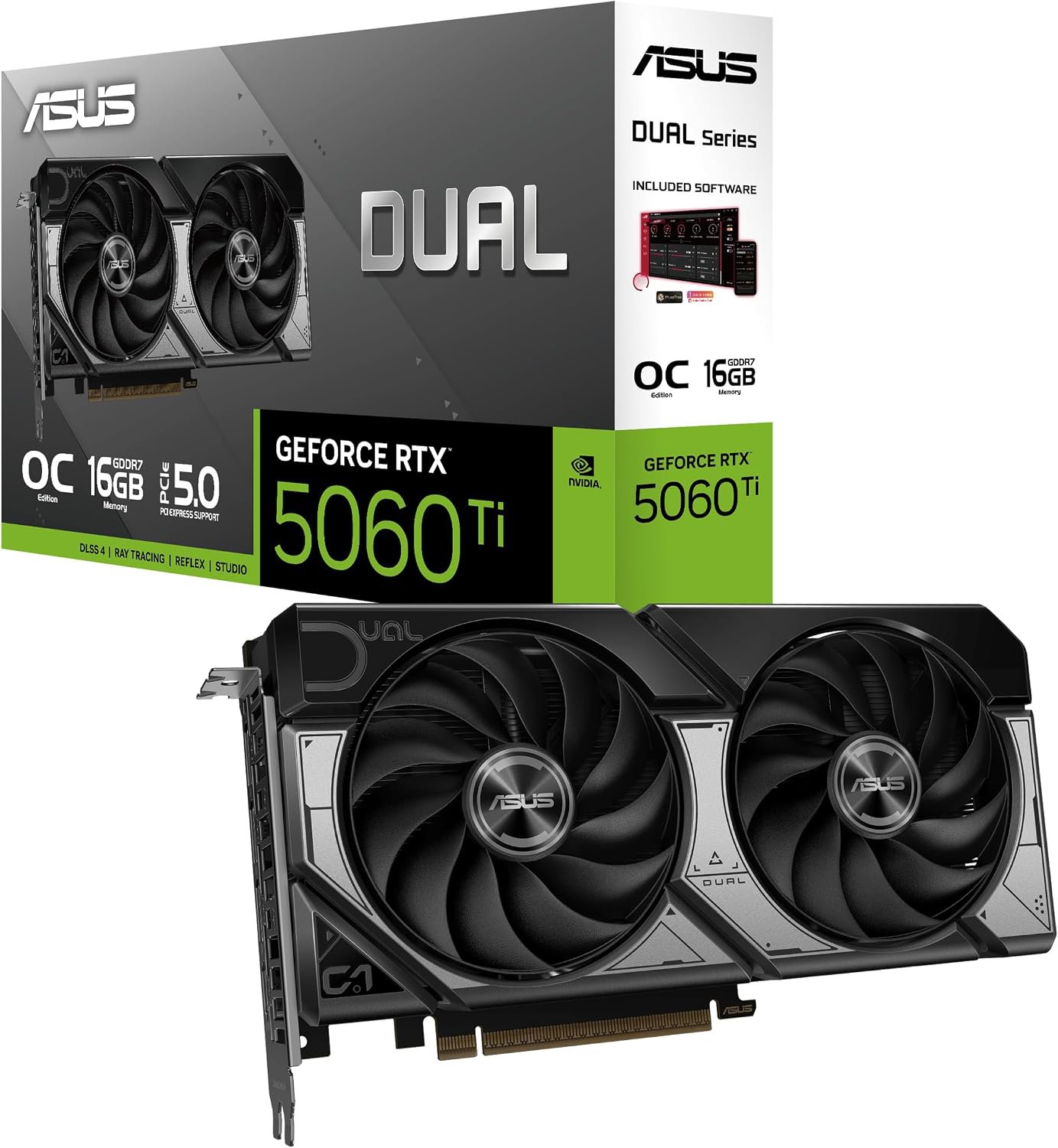
A mid-range card that actually respects your wallet
The ASUS Dual RTX 5060 Ti is a sensible, efficient choice for gamers who want 16GB of VRAM without taking out a second mortgage. It shines in compact builds and modern gaming titles, though power users might still crave the brute force of higher-tier cards.
What We Liked 👍
- Generous 16GB of fast GDDR7 memory
- Compact form factor fits most cases
- Excellent cooling with Axial-tech fans
- Dual BIOS offers silent operation modes
- Reliable Auto-Extreme manufacturing process
What Could Be Better 👎
- Price can fluctuate significantly online
- Not intended for extreme 4K gaming
- Requires decent case airflow management
Finally, VRAM that doesn't feel like a bad joke
Welcome back to the hardware circus. Today we are looking at the ASUS Dual RTX 5060 Ti OC, a card that has managed to achieve the impossible: it actually makes sense. In a market where companies love to gatekeep VRAM like it is made of compressed diamonds, having 16GB on a 5060 Ti feels like a genuine apology from the tech gods. You know the drill, spec sheets usually promise the moon and deliver a crater, but here the inclusion of GDDR7 memory suggests ASUS and NVIDIA actually listened to the complaints about VRAM limitations in modern titles.
Let us talk about the 'Dual' branding. ASUS usually keeps this line humble, and that is a compliment. It is not trying to be a massive, three-fan monstrosity that requires a custom-built support beam just to keep your motherboard from snapping. It is compact, it is gray, and it fits into your life without demanding a divorce from your current PC case. It is refreshing to see a mid-range card that understands the assignment is to play games, not to double as a space heater or a decorative light show for your cat to stare at.
Performance-wise, we are looking at a card that hits that sweet spot for 1440p gaming. With the inclusion of DLSS 4 and those 16GB of VRAM, you are future-proofing yourself against games that love to chew through memory like a starving wolf. I have seen enough cards in this segment choke on modern textures, so having this headroom is a massive sigh of relief. If you are doing anything more than gaming, like some light deep learning or heavy content creation, those extra gigabytes will be the reason you do not throw your monitor out the window in frustration.
Of course, the software experience is driven by GPU Tweak III. It is intuitive enough that you will not need a PhD to overclock your card, which is a low bar that many manufacturers still fail to clear. The dashboard is clean, and the monitoring tools are surprisingly useful. It does not feel like bloatware designed to sell you more hardware, which is a rare feat in today's ecosystem of 'optimizing' software that mostly just drains your CPU cycles.
The reality of the 5060 Ti is that it is a balanced performer. It is not going to replace a flagship card for 8K benchmarking if that is your hobby, but who actually plays at 8K? The card stays cool, the fans do their job without sounding like a turbine engine taking off, and the build quality, thanks to that Auto-Extreme process, is solid. It is a sturdy piece of kit that does exactly what it says on the box, which is a shocking change of pace for the industry.
Features that won't make you regret your life choices
The standout feature here is undoubtedly the 16GB of GDDR7 RAM. In the realm of mid-range hardware, 8GB is starting to feel like a relic of the past, and 12GB is an awkward middle ground. By jumping to 16GB, ASUS has made this card a longevity play. You are not just buying for today's AAA titles; you are buying for the ones coming out in two years that will inevitably require more graphical overhead than we can currently imagine.
The cooling solution is the unsung hero. The Axial-tech fans are built with a smaller hub, which is just fancy talk for saying they move more air without needing to spin at the speed of sound. Paired with a double ball bearing design, these fans are built to last twice as long as the sleeve-bearing fans you find on budget knock-offs. It is the kind of engineering that I can actually respect, even if I usually spend my time roasting marketing fluff.
Lastly, the Dual BIOS mode is a feature that people ignore until they really need it. Whether you are chasing every last frame in a competitive shooter with the Performance mode or trying to keep your apartment quiet while you edit video with the Silent mode, the flexibility is there. It is a simple switch on the card that actually changes how the hardware behaves. No complex software handshake required. It is low-tech charm in a high-tech world.
The verdict: Should you actually buy it?
If you are a 1440p gamer tired of seeing 'VRAM limit reached' warnings and you want a reliable, compact card that won't require a total PC overhaul, the ASUS Dual RTX 5060 Ti OC is your best friend. It is for the sensible buyer who values longevity over raw, unnecessary ego-driven power. Skip this if you are a 4K enthusiast chasing top-tier benchmarks or if you are still rocking a case from 2005 with zero airflow; this card deserves a modern home where it can breathe.